Enjoy summer ventilation without unwanted visitors
An open window is welcome on an Estonian summer evening, until mosquitoes arrive. Tiny midges can also be troublesome near the sea and in damp locations. An insect screen reduces the entry of flying insects while you ventilate in the evening or overnight.
Mesh opening size matters for very small insects: a standard screen may not stop every midge. In homes with pets, also consider claws and animals leaning against the mesh. An insect screen is not a fall-prevention barrier for children or pets.
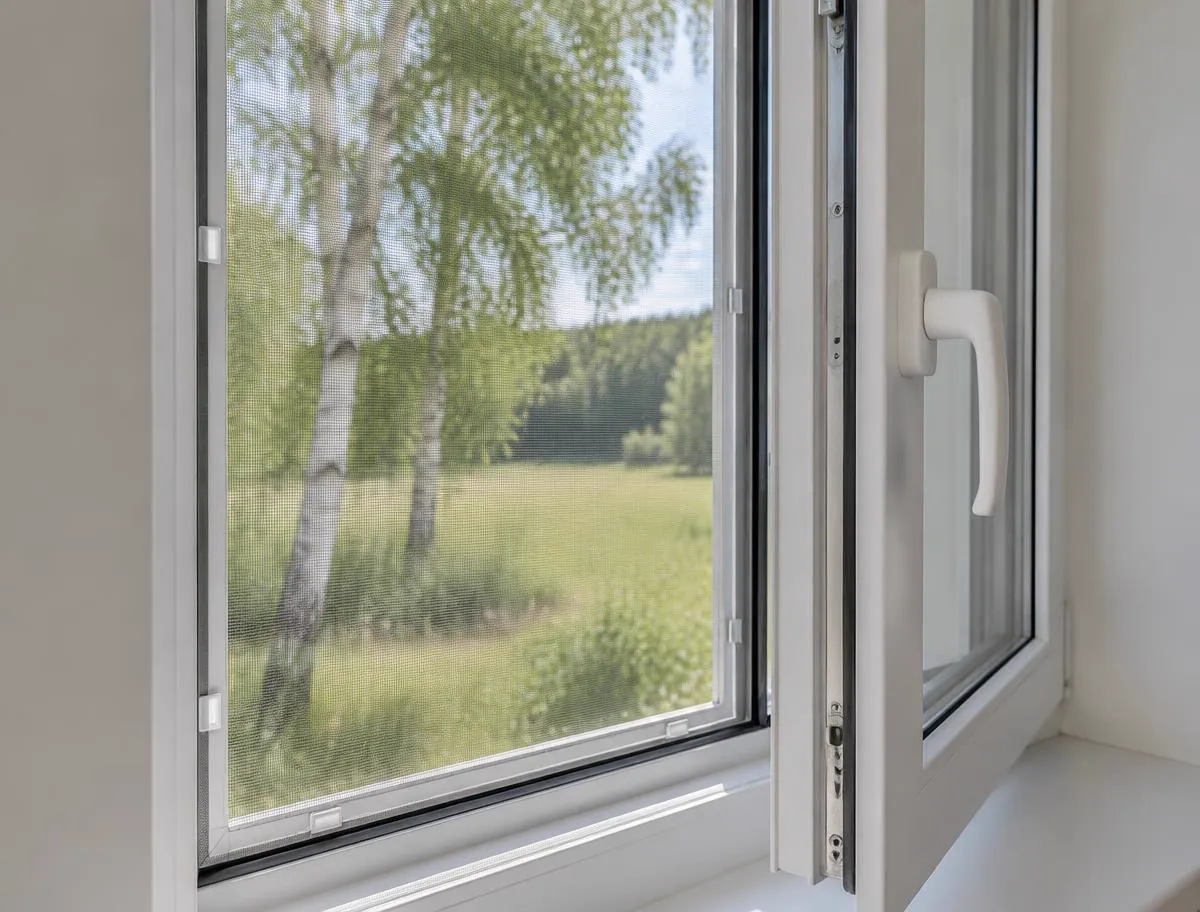
Window frame screens: simple and removable
Mesh is tensioned inside a rigid frame, which clips or hooks into suitable fixings beside the window frame. The fixing method depends on the window profile and available clearance; we check this during the site survey.
A window insect screen is €50 + VAT per opening sash. We do not add screens to fixed window sections. Where the fixing system allows, the screen can be removed for cleaning and winter storage following its instructions.
Screen frame colours follow the window colour where possible. The most common colours are white, brown and anthracite; we confirm the exact match when you order.
Hinged screen doors for regular access
A hinged screen door is a separate framed leaf in front of the main door. It needs clear space to swing open. A self-closing arrangement helps the screen close after someone passes through; closer availability and specification are confirmed when ordering.
A lower kick plate protects the mesh from footwear and minor everyday knocks. It does not turn the screen into a security door or a reliable pet-containment barrier.
A door insect screen is €220 + VAT per door leaf. On a double door with a Stulp, or floating mullion, we fit a screen only to the active leaf, not the passive leaf.
Pleated screens for sliding doors and wide openings
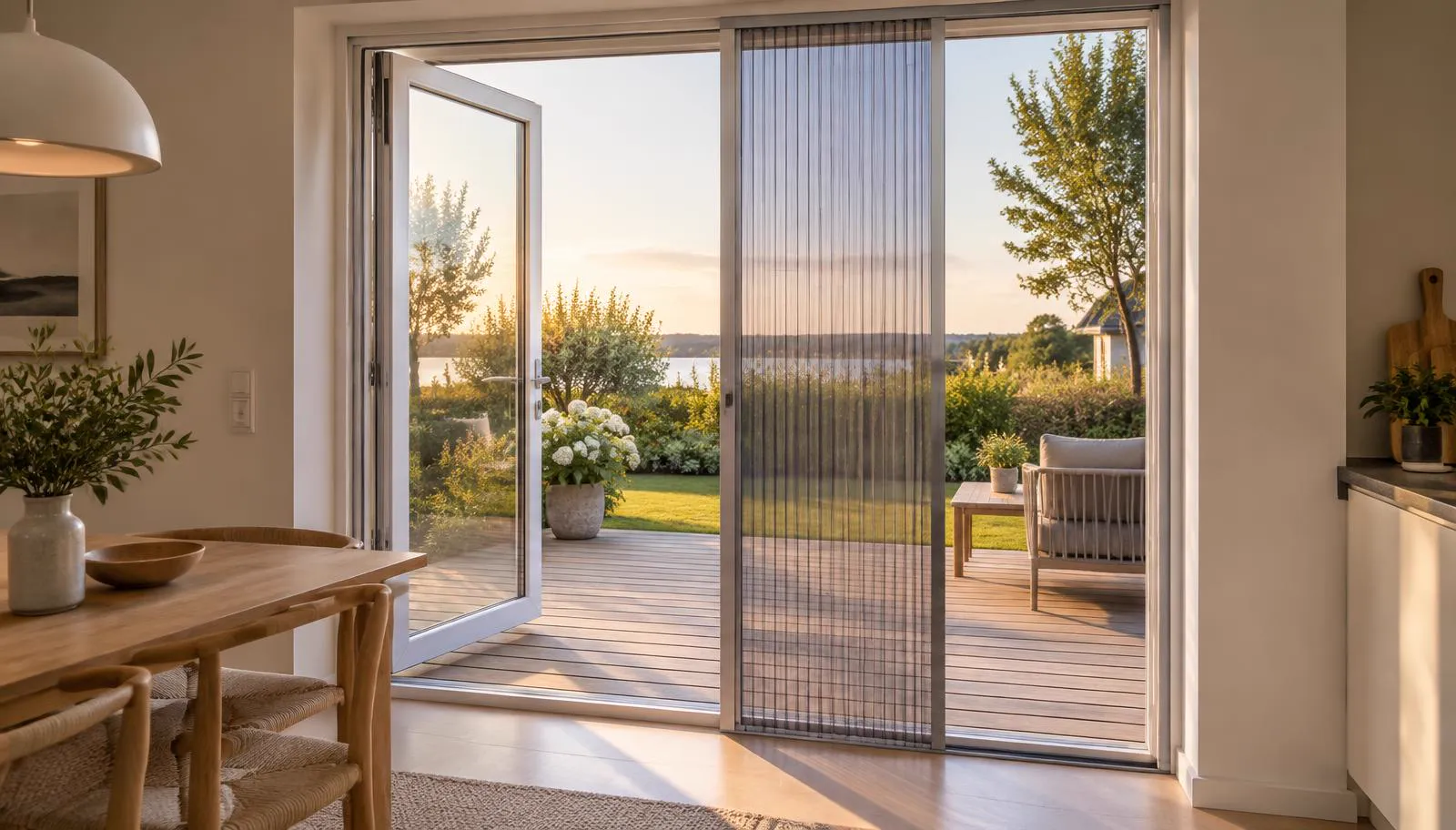
Pleated mesh folds like an accordion. Moving the handle bar sideways draws the mesh across the opening or gathers it into a compact stack at the side. No swing clearance is needed.
Top and bottom guide rails and guide cords keep the movement aligned. Unlike a spring-loaded roller screen, a pleated screen has no spring-powered retraction and stays in the position selected by hand. Its guide cords may still be under tension. A magnetic closing profile helps hold the closing edge shut; the precise arrangement depends on the system.
A low bottom guide rail makes passage easier, but it is not the same as having no threshold. We confirm the rail profile and height for the selected system and installation.
Wind resistance depends on edge retention, screen dimensions and installation. A screen is not a windbreak: fold it away in strong winds and follow the manufacturer's instructions. The layout and maximum dimensions for a wide opening are confirmed during the survey.
A pleated screen for a sliding door is €550 + VAT per sliding part. Pricing is based on the sliding parts, not the entire glazed area.
Which screen suits your opening?
| — | Window frame screen | Hinged door screen | Pleated screen |
|---|---|---|---|
| Where it fits | Opening window sash | Access door; active leaf of a Stulp double door | Sliding door or suitably divided wide opening |
| Maximum width | Depends on frame and support; confirmed at survey | Depends on leaf size and hinges; confirmed at survey | Depends on system and layout; confirmed at survey |
| Threshold | Not a walk-through screen | Bottom frame profile depends on design | Low bottom guide rail |
| Operation | Stays in place during ventilation | Swings on hinges; closer by agreement | Slides sideways and folds |
| Winter storage | Remove and store dry if fixings allow | Removal depends on hinges and instructions | Fold away; remove only as instructed |
| Wind | Secure fixings and intact mesh are important | Protect against sudden swinging and slamming | Depends on edge retention; fold away in strong wind |
| Price per chargeable unit | €50 + VAT / opening sash | €220 + VAT / door leaf | €550 + VAT / sliding part |
| Durability | Simple construction; sharp objects can damage mesh | Check hinges and closer; kick plate protects lower area | Folds and rails need cleaning and gentle handling |
There is no universal maximum width or lifespan for every system. Special-mesh compatibility and any price change are confirmed in the quotation.
Strengths and limitations of each type
Window frame screen
Pros
- Simple construction and use
- Removable for cleaning and winter storage
Cons
- Not suitable for walking through
- Needs storage space when removed
Hinged door screen
Pros
- Convenient for frequent access
- Self-closing and kick-plate options
Cons
- Needs swing clearance
- Wind can move an open leaf suddenly
Pleated screen
Pros
- No swing clearance needed
- Suitable for wide openings with an appropriate layout
Cons
- Guide rail must be kept clean
- Folds must not be pressed or forced
Mesh choices: visibility, airflow or extra strength?
These mesh categories help identify your priorities, but not every fabric suits every screen. Pleated systems in particular need compatible folding mesh. We confirm special-mesh availability before you order.
- Standard fibreglass mesh is a common window and door choice, balancing insect protection, outward visibility and airflow.
- Pet-resistant mesh is stronger and better able to withstand claws than standard mesh. Thicker strands can be more visible and restrict airflow. It is not a fall-prevention barrier or a guaranteed means of containing an animal.
- Pollen mesh helps reduce incoming pollen. Performance depends on the fabric, pollen type and installation; it does not make a room allergen-free. Airflow may be lower than through standard mesh.
- Clear-view or 'invisible' mesh uses finer strands to make the screen less noticeable. 'Invisible' is a descriptive name, not a promise that the mesh cannot be seen.
- For tiny midges, ask about an appropriate mesh opening size. Finer screening needs to be considered alongside its effect on airflow and visibility.
How to order and arrange measuring
- 1
Add screens in the calculator
Select a screen separately for each window or door that needs one. The price appears instantly. Window screens are available for opening sashes, not fixed sections.
- 2
Tell us how you will use them
Mention pets, pollen sensitivity and exposed locations. For a Stulp double door, we include a screen only on the active leaf.
- 3
We measure on site
Approximate opening dimensions are enough for initial selection. On site, we check exact dimensions, handle clearance, fixings, opening direction and space for the bottom guide rail.
- 4
Confirm and install
We agree on the screen type, colour and any special-mesh option. When you order new windows, we arrange screen installation with the windows and show you how to use them.
Care and winter storage
Remove dust with a soft brush. Where the mesh instructions permit washing, use lukewarm water and mild detergent, rinse gently and allow it to dry. Avoid pressure washers, sharp tools and strong solvents.
Clear sand, leaves and debris from the pleated screen's bottom rail. Move the screen by its handle rather than pulling the mesh. Do not force a frozen or jammed screen, or apply an unapproved oil to its guides.
Store removed frame screens dry and protected, without bending the frame or resting objects against the mesh. Label each screen with its window location. Door and pleated screen removability depends on the system: do not dismantle the mechanism yourself.
In spring, check fixings, corners, mesh condition and door closing. Service life depends on the fabric, weather exposure, use and care; a single lifespan cannot be promised for every screen.
Screens for windows and sliding doors